
It would be abnormal for me not to frame my content around the severity of our situation and this time will be no different. This context might seem as just background info, or a call to action, but it’s honestly the entire argument. If you’re not framing everything we do in this context, then you’ll have a huge blind spot and will be surprised but the insane change we are about to witness in our world, our ecosystem, and the way we live. Professor Albert Bartlett said that “The greatest shortcoming of the human race is man’s inability to understand the exponential function”. Exponential curves govern every part of life, and if you want to understand how quickly the world will change, I suggest digging into S-curve rates of adoption and what is already happening. The world has already fundamentally changed, most people just haven’t realized it yet. If you want a 3 min explainer, see this video.
The climate crisis will change everything about the way we live, and the built environment is on the front lines of this crisis. Wildfires that once burned hundreds of thousands of hectares now burn millions. Floods that were once-in-a-century events now arrive on a near-annual basis. The permafrost that underlies much of northern Canada is thawing, releasing methane at a scale we are only beginning to measure. Global average temperatures have now breached 1.5°C of warming, not as a future projection, but as a present reality (and double that in northern climates like Edmonton). We are in an ecological crisis as well. We have crossed 6 of the 9 planetary boundaries, having ravaged our waters, soil and many other ecosystems beyond repair. This is almost more terrifying because we forgot that humans need healthy ecosystems to survive. We are intrinsically tied to nature. The planet does not care about our economy, and you cannot build an economy without clean water, soil to grow food and clean air to breathe. And yet, if you walk through most Canadian cities today, you would have very little indication that anyone is in a hurry.
The science is unambiguous. Buildings account for nearly 40% of global carbon emissions and commercial and large residential buildings are a disproportionate part of that problem. A single mid-size office tower or apartment complex can consume more energy in a year than hundreds of single-family homes combined. These buildings run on methane (natural gas) for heating, for hot water, for the baseline thermal loads that keep them operational year-round, and they will continue to do so for decades unless someone makes a deliberate decision to change that.
What makes this especially difficult to accept is that we already know what needs to happen. The Pan-Canadian Framework on Clean Growth and Climate Change set a clear target: all new buildings should be net-zero energy ready by 2030. That is four years away. Four years. And if you've been in a room with builders, developers, building owners, or property managers recently, you know that almost nobody is talking about it. There is no scramble. There is no urgency. There is, in most cases, barely an awareness that the target exists.
Meanwhile, the ecosystems we depend on are not waiting for us to catch up. Globally, we are losing species at a rate estimated to be 1,000 times the natural background extinction rate. Coral reefs (which support roughly 25% of all marine species) are bleaching and dying at unprecedented scale. The boreal forests of Canada, some of the most carbon-dense ecosystems on the planet, are burning faster than they can regenerate. These are not abstract environmental concerns. They are the collapse of the biological systems that regulate our climate, filter our water, and underpin our food supply. Every tonne of carbon we don't eliminate from our buildings is a direct contribution to that unravelling.
Here is what is maddening: the solutions are not complicated. I have talked about this ad-nauseum, achieving net zero or close to is not difficult. Nor does it have to be expensive. If that wasn’t enough, well, maybe here’s the kick we needed.
There is a new Investment Tax Credit (refundable) available federally that will give you up to thirty percent back on investments in clean energy technology (Geothermal, solar etc…). It is one of the most significant clean energy incentives in Canadian history. It applies directly to the technology that can transform how buildings are heated and cooled, and the vast majority of building owners have never heard of it; let’s change that.
Quick note: The full 30% rate requires electing to meet federal labour requirements which include wage and apprenticeship conditions; if those conditions aren’t met, the rate drops to 20%. The 30% rate applies to property in service through 2033, falling to 15% in 2034 before the credit ends.
If you’ve read my previous articles you know that we’re huge proponents of the “active” approach to Net Zero (see this article for context), but to summarize, the passive approach to net zero (where you just throw money at the envelope) ignores the reality of the relationship of heat and energy. Envelope upgrades have a very steeply declining curve of diminishing returns; the more insulation you add the less effective it is. So the active approach recognizes this fact and optimizes the building R-values to an optimal point that balances thermal comfort, cost and heat loss. That point is honestly not that much past where we already build, that’s the good news. Then we use energy recovery on the fresh air systems and geothermal heating and cooling to bridge the gap. This is the power of geothermal systems, they are so efficient that they can makeup for inefficiencies in the envelope, and they actually flatten that diminishing return curve even further. As an example, my net zero home will have R23 walls, R35 roof and triple pane fibreglass windows. Those are pretty conventional R-values honestly. With the addition of an ERV and Geothermal, I’ll achieve Net Zero easily. We have also implemented this approach many times in commercial/institutional net zero buildings. Point is, net zero is EASY, if you know how to do it. And the key to all of it, are geothermal systems. (One caveat here: the tax credits discussed here apply to business and institutional assets, not personal residences, so my own home build doesn't qualify for the ITC or accelerated CCA — it's included above purely as a technical illustration of what's achievable.)
Honestly, the only disadvantage to geothermal systems has been cost. For commercial and larger buildings it isn’t a lot (<1% of building cost), and for some buildings (schools, large office buildings) it can actually be cheaper. But the first cost is still a barrier to many, especially when all other costs are rising, renewables are often the first to get cut. But not anymore.
To really understand the significance of this tax credit, and why I’m claiming the system is almost free when it’s only a 30% tax credit, let’s look at the details of how this tax credit applies. But, let’s also do a disclaimer. I AM NOT an accountant, I don’t know your corporation or how it’s structured or your tax situation or the details of how you can write this off etc… Please take this as general information from an engineer, not definitive advice from an account. All that said, this is our best understanding given the information we have received.
Before diving into the mechanics, it’s also worth clarifying something: the Clean Technology ITC is only available to taxable Canadian corporations and to mutual fund trusts that are REITs. It doesn't extend to municipalities, school boards, universities, or other tax-exempt public bodies unless the project is structured through a taxable corporate entity or private partner. A related but separate credit, the Clean Electricity ITC, offers 15% to certain municipally- and Indigenous-owned corporations, but it's aimed at electricity generation rather than the heating and cooling equipment discussed here. If you're a public-sector building owner, this is the first thing to sort out with your advisor before assuming the numbers below apply to your project. A few other rules worth knowing: the credit is claimed on your corporate tax return and paid out after CRA reviews the claim, so it reimburses capital already spent rather than reducing the upfront cost directly; the equipment has to be new, not used or previously acquired by anyone else; you can only claim one Clean Economy ITC per dollar of eligible property; and the credit can be recaptured if the equipment stops being used for its eligible purpose or is disposed of early.
Below is a schematic showing what is eligible and what is ineligible for the tax credit (this is from the accelerated capital cost allowance tax credit guidance document but it applies the same here).
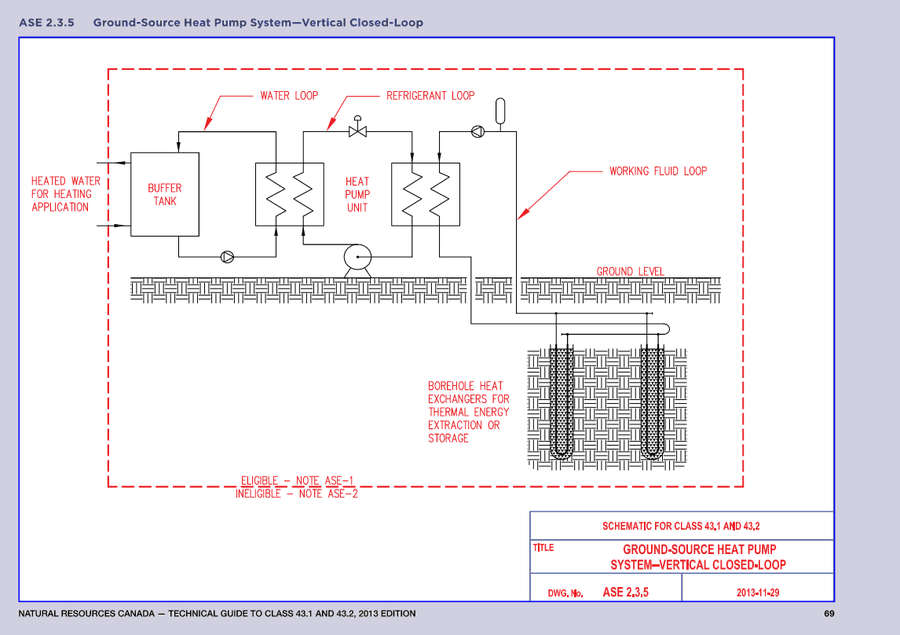
The significant take away here is that it is not JUST the ground loop where this tax credit applies, this credit applies also to the hydronic loop to and from the heat pumps, to the circulation pumps, any buffer tanks and hydronic equipment, the engineering costs, AND the heat pumps themselves. That is HUGE. Let me explain.
As a general rule of thumb, unless it’s a larger more complex building and HVAC system (where geo systems can actually cost less), the cost of the ground loop itself is often the approximate cost premium. The indoor hvac equipment is often a similar cost or directly equivalent (for example, an apartment building which has heat pumps in both the geo and traditional scenario). In that case you would also reduce that cost premium by the cost of the boiler and cooling tower or chiller you are replacing. The table below shows this comparison for a MURB of approximately 8000 m2 in size. The table shows a traditional system where you have distributed heat pumps fed by a boiler and cooling tower, versus a Geo case where you replace the boiler and cooling tower by a geothermal system (the ground loop). Note that this is an illustrative example meant to show how the credits apply.
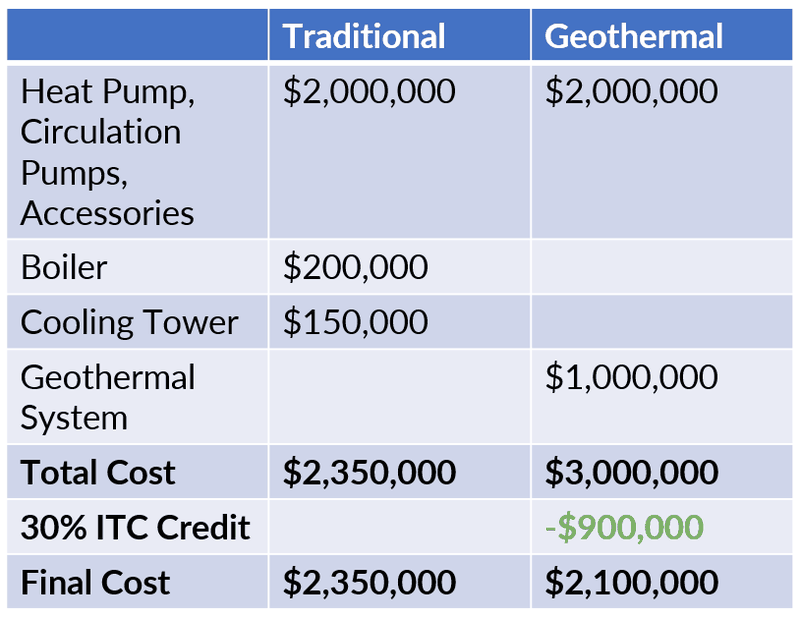
You can see above that the cost premium would normally be $650,000 for the geothermal system. Not huge in the context of the building, but still often a barrier.
Now here’s the big deal part. Because you can claim the ITC on not just the ground loop ($1 million), but also the building heat pumps ($2 million), you can claim 30% of $3 million, which is $900,000. So once you claimed that credit, the ground loop is literally FREE!! Even if you claim only a 20% tax credit (discussed later), you are still only paying $50,000 for the ground loop.
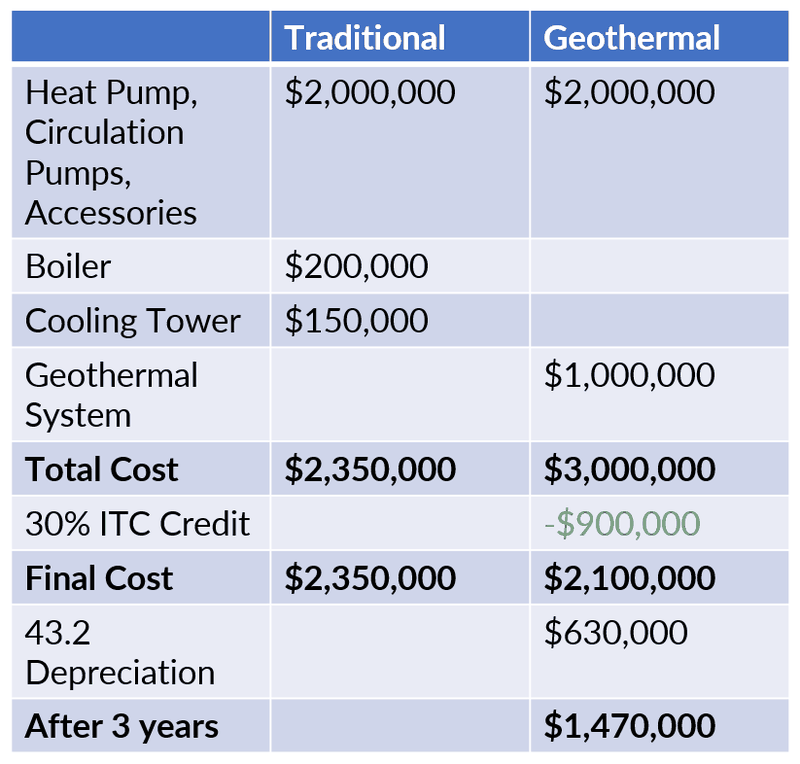
Another thing to speak to your accountant about, and something that can make this even more enticing, is that you may be able to stack accelerated depreciation on top of the ITC. Unlike the ITC, this isn't a credit. The Accelerated Capital Cost Allowance (CCA), is a decades-old incentive letting owners of Geothermal and Solar equipment write off those assets much faster than normal. Because it's a deduction, not a refund, the actual dollars you save depend on your marginal tax rate rather than a flat percentage. The rate itself has changed recently: equipment acquired before 2025 could depreciate at 50%/year (Class 43.2), but equipment acquired in 2025 or later falls under Class 43.1 at a 30% declining-balance rate, though reinstated immediate-expensing rules mean that same equipment may still qualify for up to a 100% first-year deduction if it's in service before 2030, phasing down afterward. The chart below shows what full first-year expensing could look like applied to the remaining ITC-adjusted amount ($2,100,000). Word of warning: these rules have shifted substantially in the last two years, so confirm the current class and rate with your accountant before relying on this for a specific project.
Sources: Canada Revenue Agency, "Clean Technology Investment Tax Credit" and "Who can claim" (canada.ca); Canada Revenue Agency, "Classes of depreciable property" and "Accelerated investment incentive" (canada.ca); Government of Canada, "Clean Economy Investment Tax Credits" overview (canada.ca).
While it’s disappointing that incentives don’t exist to help municipalities and non-profits invest in these technologies, this is still a big deal. Any corporation building a new building or retrofitting an existing building should be looking at this very seriously. These tax incentives are a game changer for anyone that wants to invest in clean technology, save energy and money, and protect themselves from future energy risks. Geo systems have become literally a No-brainer. When you get the best mechanical system on the market, that aligns with a net zero future, which reduces your heating/cooling energy use by 70-80%, reduces operating and maintenance costs, improves comfort, eliminates pollution, reduces equipment replacement costs (ground loop lasts 100-200 years), and you get that for almost free. You’d be silly not to.
A reminder to all building owners: Installing fossil fuel infrastructure today is basically installing a stranded asset that you will need to replace within the next 5-15 years, possibly sooner depending on energy prices and future carbon taxes and laws. The climate crisis is not going anywhere, in our opinion, this is a really risky bet that things will stay the same.
If you’re curious how you can implement geo on your building, give us a shout.
2013 © Revolve Engineering Inc. - ALL Rights Reserved.
